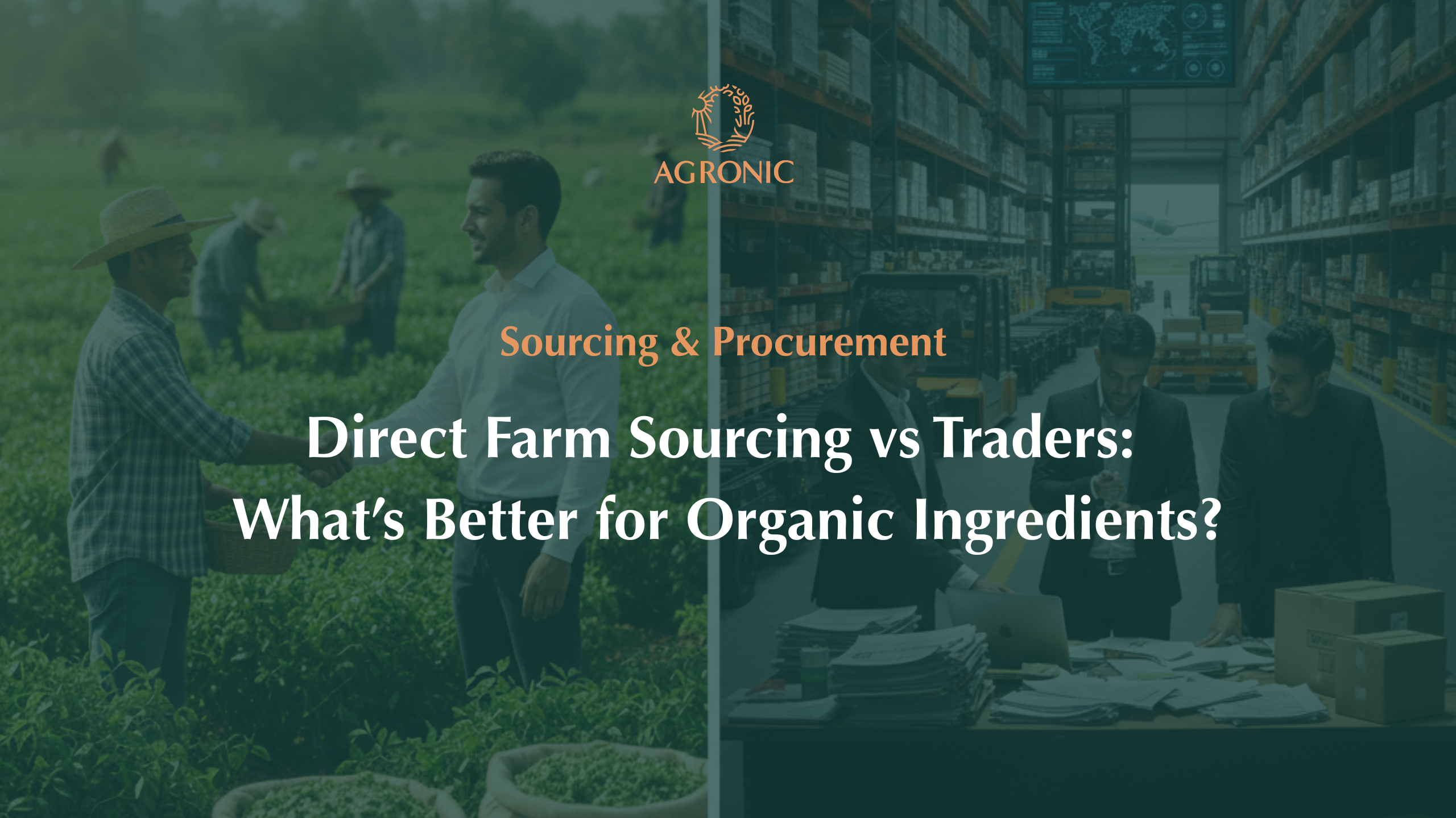
Direct Farm Sourcing vs Traders: What’s Better for Organic Ingredients?

Introduction: Why Sourcing Models Matter in Organic Ingredients
As global demand for organic food ingredients continues to rise, importers and food manufacturers are becoming more selective about how and where their ingredients are sourced. Beyond certifications and pricing, the sourcing model plays a critical role in determining product quality, traceability, supply consistency, and long-term risk.
When sourcing organic spices, starches, or botanical powders—especially from origin countries like India—buyers typically encounter two models:
- Direct farm sourcing
- Trader or intermediary-based sourcing
At first glance, both models may appear similar. However, the long-term implications for compliance, reliability, and brand integrity can be very different.
This blog provides a detailed comparison of direct farm sourcing vs traders, helping importers, procurement managers, and private-label brands decide which model best supports their organic sourcing goals.
Understanding the Two Sourcing Models
What Is Direct Farm Sourcing?
Direct farm sourcing means the exporter or processor works directly with certified organic farmers or farmer groups. The supplier manages procurement, processing, quality control, documentation, and export under a single, integrated system.
This model emphasizes transparency, traceability, and long-term partnerships with growers.
What Is Trader-Based Sourcing?
In trader-based sourcing, the exporter or buyer purchases organic ingredients through multiple intermediaries, such as local traders, aggregators, or brokers. The trader may not be involved in farming or processing and often consolidates material from various sources.
While this model may offer short-term convenience, it introduces additional complexity and risk.
1. Traceability: The Foundation of Organic Integrity
Direct Farm Sourcing Advantage
Traceability is one of the most important requirements in organic supply chains. With direct farm sourcing:
- Each batch can be traced back to a specific farm or farmer group
- Farm records, inspection reports, and harvest data are easily accessible
- Batch-level traceability is maintained through processing and export
This level of transparency is critical for meeting regulatory requirements and buyer audits.
Trader-Based Challenges
Trader-based sourcing often involves:
- Multiple farms consolidated into a single lot
- Limited visibility into farm-level practices
- Inconsistent or incomplete traceability records
In the event of a compliance issue, tracing the problem back to the source becomes time-consuming and risky.
Buyer Insight:
Regulators and certification bodies increasingly expect full farm-to-shipment traceability. Direct sourcing makes this significantly easier.
2. Quality Control and Consistency
Direct Farm Sourcing
Suppliers working directly with farmers can:
- Implement standardized cultivation practices
- Monitor crop quality throughout the season
- Provide training on organic compliance and post-harvest handling
This results in more consistent quality across batches, which is especially important for food manufacturers and brands.
Trader-Based Sourcing
Traders often procure material based on availability rather than consistency. As a result:
- Quality may vary between batches
- Processing parameters may differ
- Buyers may experience fluctuations in color, aroma, or potency
For repeat buyers, this inconsistency can disrupt production and formulation stability.
3. Certification Control and Compliance
Why Certification Scope Matters
Organic certification is not just a label—it is a system that must be managed carefully.
Direct Farm Sourcing Benefits
With direct sourcing:
- Certification scope is clearly defined
- Farm certificates, group certifications, and transaction certificates are aligned
- Documentation errors are minimized
Suppliers are better equipped to respond to audits and buyer compliance checks.
Trader-Based Risks
Traders may:
- Source from farms with different certification statuses
- Provide incomplete or mismatched documentation
- Struggle to produce transaction certificates quickly
This increases the risk of shipment delays or rejection at customs.
4. Pricing Transparency and Cost Stability
Direct Farm Sourcing
While direct sourcing may not always offer the lowest upfront price, it provides:
- Transparent cost structures
- Reduced middlemen margins
- More stable long-term pricing
Buyers benefit from predictable costs and fewer surprises.
Trader-Based Sourcing
Trader pricing can be:
- Volatile due to market speculation
- Influenced by short-term availability
- Less transparent
In some cases, lower prices may reflect compromises in quality, traceability, or compliance.
5. Supply Reliability and Scalability
Direct Farm Sourcing
Suppliers with direct farmer relationships can:
- Plan cultivation based on demand forecasts
- Secure volumes in advance
- Scale supply more reliably over time
This is especially important for brands planning long-term growth.
Trader-Based Sourcing
Traders often rely on spot-market availability. This can lead to:
- Supply shortages during peak demand
- Difficulty securing repeat volumes
- Increased competition for raw materials
For importers, this unpredictability creates operational risk.
6. Risk Management and Recall Readiness
Direct Farm Sourcing
In the event of a quality or compliance issue:
- The affected batch can be isolated quickly
- Root cause analysis is more effective
- Corrective actions can be implemented at farm level
This reduces recall scope and protects buyer reputation.
Trader-Based Sourcing
With multiple unknown sources:
- Issue identification is slower
- Recall scope may be broader
- Buyer exposure increases
From a risk management perspective, direct sourcing offers stronger safeguards.
7. Sustainability and Ethical Sourcing
Direct Farm Sourcing
Direct relationships enable:
- Fair and consistent pricing for farmers
- Long-term farmer engagement
- Adoption of sustainable farming practices
This aligns well with modern brand values and sustainability commitments.
Trader-Based Sourcing
Traders may focus on volume and price rather than:
- Farmer welfare
- Environmental impact
- Long-term sustainability
For brands emphasizing ethical sourcing, this can be a limitation.
8. Customization and Buyer Support
Direct Farm Sourcing
Suppliers working closely with farms and processing units can offer:
- Customized specifications
- Consistent mesh size or potency
- Tailored packaging and labeling
This flexibility supports product development and private-label programs.
Trader-Based Sourcing
Customization is often limited, as traders work with pre-available material rather than planned production.
9. Communication and Accountability
Direct Farm Sourcing
With fewer intermediaries:
- Communication is clearer
- Accountability is defined
- Issues are resolved faster
Buyers deal directly with decision-makers.
Trader-Based Sourcing
Multiple intermediaries can result in:
- Delayed responses
- Conflicting information
- Reduced accountability
This can frustrate buyers and slow operations.
When Trader-Based Sourcing May Still Make Sense
Trader sourcing is not always wrong. It may be suitable when:
- Buyers need very small, one-time volumes
- Ingredients are not critical to brand positioning
- Speed is more important than traceability
However, for core organic ingredients, most buyers prefer direct sourcing.
How Buyers Can Identify Direct Farm Sourcing Suppliers
Ask suppliers:
- Do you work directly with certified farmers or farmer groups?
- Can you provide farm-level traceability records?
- How long have you partnered with your farmers?
- Do you support farmers with training or inputs?
Comparison Summary: Direct Farm Sourcing vs Traders
| Factor | Direct Farm Sourcing | Trader-Based Sourcing |
| Traceability | High | Limited |
| Quality Consistency | Strong | Variable |
| Certification Control | Clear | Risk Prone |
| Pricing Transparency | High | Often Unclear |
| Supply Reliability | Stable | Unpredictable |
| Sustainability | Strong | Limited |
Conclusion: Which Model Is Better for Organic Ingredients?
For importers, food manufacturers, and global brands, direct farm sourcing is generally the superior model for organic ingredients. It offers stronger traceability, better quality control, improved compliance, and long-term supply stability.
While trader-based sourcing may work for short-term or non-critical needs, it carries higher risks in an increasingly regulated and transparency-driven organic market.
Choosing the right sourcing model is not just a procurement decision—it is a strategic investment in quality, compliance, and brand trust.
If you are looking to source certified organic ingredients through direct farm partnerships in India, with strong traceability, quality control, and export readiness, connect with Agronic Food to explore reliable and sustainable sourcing solutions.