
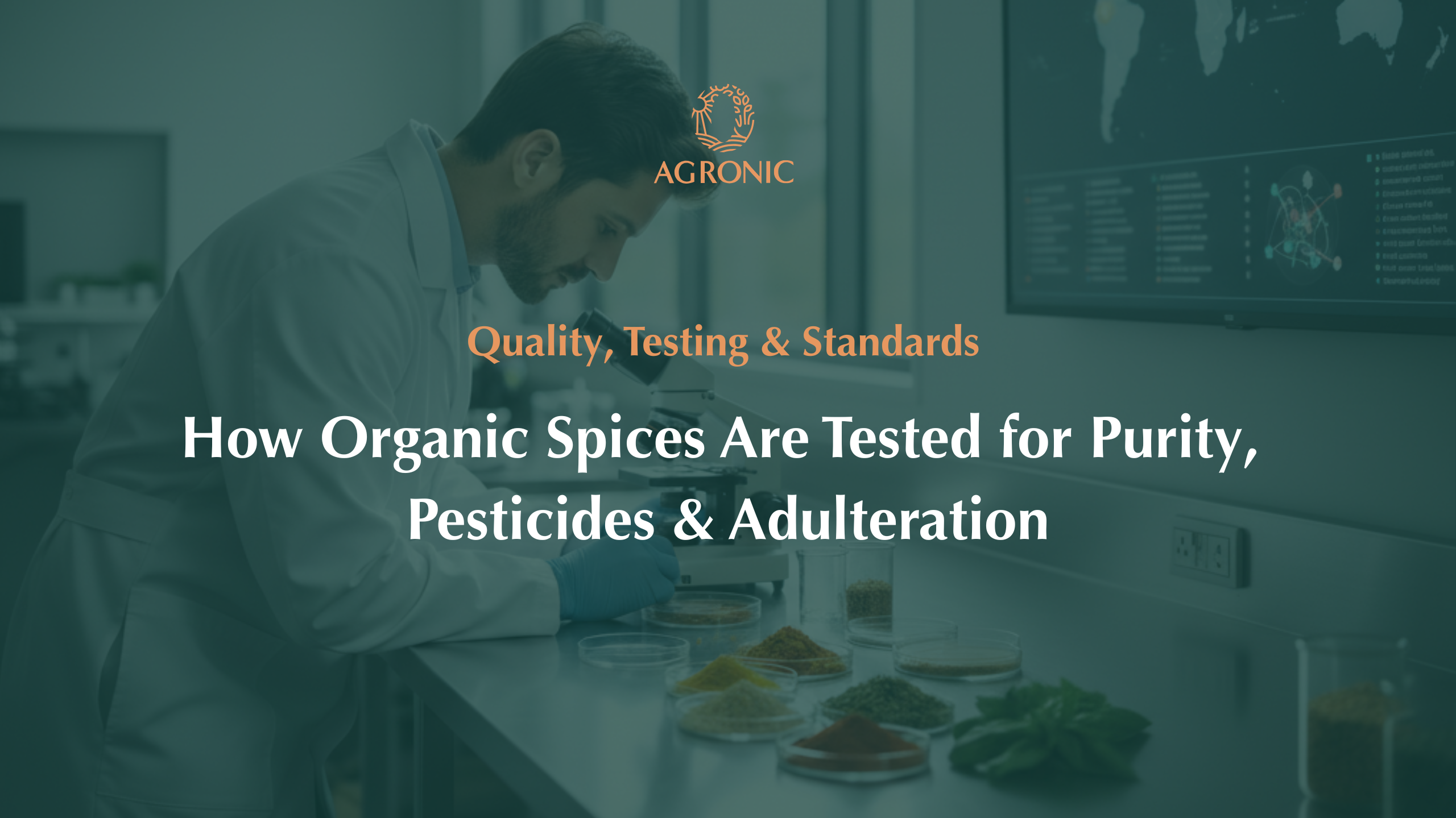
How Organic Spices Are Tested for Purity, Pesticides & Adulteration

Introduction
Organic certification tells you how a spice was grown. Laboratory testing tells you what’s actually in it.
For importers sourcing organic turmeric, ginger, cumin, coriander, black pepper, or other spices, certification is the starting point — not the finish line. Testing is what confirms each batch is safe, pure, and compliant with the regulations of your destination market.
Here’s a straightforward breakdown of how organic spices are tested and what buyers should be verifying.
Why Certified Organic Spices Still Need Testing
Organic certification prohibits synthetic pesticides and chemicals at the farm level, but it doesn’t eliminate every risk. Contamination can still occur through:
- Soil or water carrying residues from neighboring conventional farms
- Cross-contamination during processing or storage
- Microbial growth during transport
- Adulteration somewhere in the supply chain
Testing provides documented proof that a specific batch meets food safety standards — not just that the farm follows organic practices in general. For importers, that distinction is critical.
Pesticide Residue Testing
This is one of the most important safety checks in organic spice imports. Even with organic farming practices in place, pesticide residues can appear due to environmental drift, residual soil contamination, or cross-contact during storage.
Labs use methods like GC-MS (Gas Chromatography-Mass Spectrometry) and LC-MS/MS (Liquid Chromatography-Tandem Mass Spectrometry) to detect residues at extremely low levels — often in parts per billion.
What buyers should ask:
- Is every batch tested, or only periodic samples?
- Are tests conducted by accredited third-party labs?
- Do results comply with Maximum Residue Limits (MRLs) in your destination market?
MRL thresholds differ between markets — the EU generally enforces stricter limits than other regions — so make sure testing is aligned with where you’re importing.
Heavy Metal Testing
Heavy metals like lead, arsenic, cadmium, and mercury can accumulate in spices through contaminated soil or water. Turmeric in particular has faced scrutiny in global markets due to lead concerns.
Labs use ICP-MS (Inductively Coupled Plasma Mass Spectrometry) to test for these metals with high precision. Importers should ensure results comply with both regulatory limits and their own internal safety specifications — since some retailers set stricter standards than regulators.
Heavy metal issues can trigger product recalls, regulatory rejection, and lasting brand damage, making this a non-negotiable test for any serious organic spice buyer.
Microbial Testing
Spices are agricultural products and naturally exposed to environmental microorganisms. Poor drying, inadequate storage, or contaminated processing environments can lead to dangerous microbial loads.
Key parameters tested include:
- Total Plate Count (TPC)
- Yeast and mold
- E. coli
- Salmonella
- Coliform bacteria
This matters especially because spices are often added to finished food products without further cooking. Always request a Certificate of Analysis (COA) that confirms compliance with microbial standards before accepting a shipment.
Adulteration Testing
Spice adulteration is a known issue in global trade. Common examples include artificial coloring agents added to turmeric, mixing lower-grade material into premium batches, or dilution with foreign matter.
Testing methods used to detect adulteration include microscopic analysis, chemical marker testing, DNA-based botanical authentication, and spectroscopy. Authenticity testing protects buyers from fraud and ensures product consistency across batches.
Moisture Content and Physical Parameters
High moisture content shortens shelf life and creates conditions for mold growth. Physical testing typically covers:
- Moisture percentage
- Mesh size (for powders)
- Bulk density
- Color value
These parameters affect both product quality and storage stability. Reliable exporters monitor moisture carefully throughout processing and packaging.
Batch-Level Testing vs Periodic Testing
Testing should happen at the batch level — not randomly across general inventory. Batch-specific testing ensures each shipment individually meets compliance standards, and if an issue arises, it can be isolated and traced quickly.
Always confirm that lab reports reference specific batch or lot numbers. A COA without batch identification isn’t truly verifiable.
Third-Party Testing vs In-House Testing
In-house testing can be useful for routine quality checks, but for export markets, third-party accredited laboratory testing carries significantly more credibility. Independent testing provides unbiased verification and is generally required or expected by serious buyers and regulators alike.
When reviewing supplier COAs, check that the issuing lab is accredited under recognized standards such as ISO 17025.
Market-Specific Requirements
Different markets set different safety thresholds. The EU often enforces stricter pesticide residue limits, while the U.S. FDA emphasizes specific microbial standards. Some markets require additional contaminant screening beyond the standard parameters.
Make sure your supplier’s testing protocols are aligned with the regulations of your specific destination market — not just generic international benchmarks.
What Buyers Should Request Before Each Shipment
Before approving dispatch, importers should have:
- Updated Certificate of Analysis with batch reference
- Test method details
- Laboratory accreditation information
- Results that align with destination market MRLs and safety limits
You can also arrange independent third-party testing upon arrival to validate supplier results — particularly useful when onboarding a new supplier or after any quality concern.
Testing Is Part of a Broader Quality System
Testing works best when it’s embedded in a broader quality management framework. Reliable organic spice exporters typically operate under HACCP (Hazard Analysis and Critical Control Points) and GMP (Good Manufacturing Practices), with documented procedures for sampling, testing, and record-keeping.
A single COA is useful. A supplier with systematic quality control is dependable.
The Cost of Skipping Tests
Reducing testing to cut costs is a false economy. A single contaminated shipment can result in port rejection, costly recalls, lost buyer contracts, and reputational damage that takes years to recover from. The cost of comprehensive testing is minor by comparison.
Final Thought
Organic spice testing isn’t a formality — it’s how you verify that certification claims hold up in practice. Pesticide residues, heavy metals, microbial contamination, and adulteration are real risks in global spice supply chains, and testing is the most reliable defense against all of them.
Importers who build testing verification into their procurement process reduce risk, protect their brand, and build the kind of supplier relationships that last.
Sourcing certified organic spices and need comprehensive testing coverage across pesticide residues, heavy metals, microbial safety, and purity? Connect with Agronic Food for consistent quality and fully documented organic spice exports.